Sonos vs Bose home theater compared
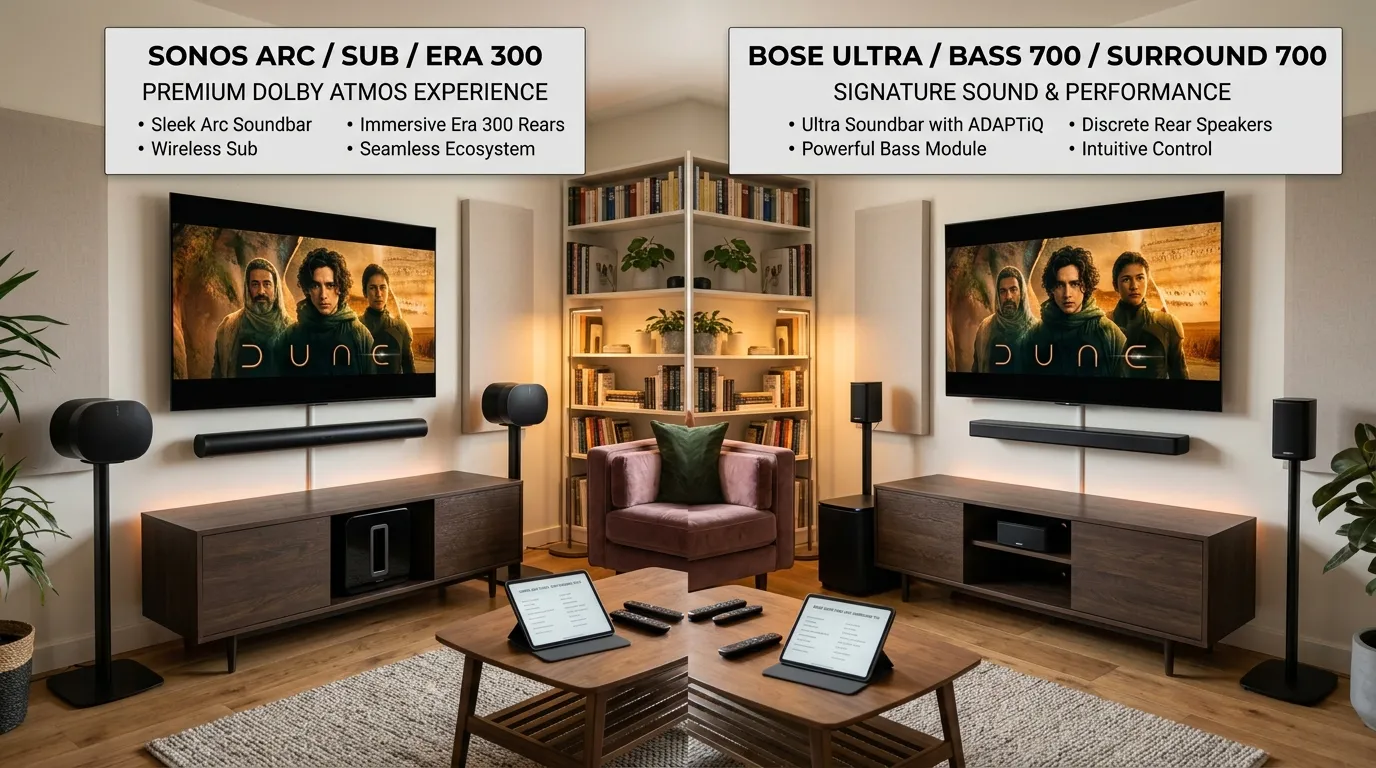
If you're deciding between Sonos vs Bose home theater compared for your living room, you're weighing two pioneers of premium sound. Both brands deliver immersive audio experiences, but they differ in technology, design, and ecosystem integration. Sonos offers models like the Arc Ultra with groundbreaking Sound Motion technology for enhanced bass and a spacious soundstage, while Bose focuses on clarity and balanced sound with their signature audio engineering.
This comparison covers the latest 2026 home theater systems from both brands, highlighting their sound quality, smart features, setup ease, and pricing to help you make an informed choice. Whether you prioritize Dolby Atmos support or seamless multi-room convenience, this guide breaks down what to expect from flagship models such as Sonos Arc Ultra and Bose's competitive alternatives. Get ready to discover which system matches your home entertainment style best.
Did You Know?
Sonos Arc Ultra features Sound Motion technology that delivers twice the bass impact compared to previous models, elevating your home theater experience.
Source: Sonos Official
Overview of Sonos Home Theater Systems
Sonos leads the pack in wireless home theater with its highly regarded lineup, featuring the Sonos Arc Ultra and Sonos Beam Gen 2 as the standout soundbars. These systems bring immersive Dolby Atmos sound to living rooms of all sizes, wrapped in a sleek, modern design that complements any home setup.
The flagship Sonos Arc Ultra is a powerhouse designed for audiophiles who crave cinematic sound quality. Its advanced Dolby Atmos support is amplified by proprietary Sound Motion technology, which delivers double the bass impact compared to earlier Arc models. This is achieved with an expanded array of 11 drivers, including specially tuned tweeters and mid-range speakers, producing a wider soundstage with rich mids, crystal-clear highs, and deep, controlled bass that reverberates without distortion. Trueplay tuning technology automatically calibrates the Arc Ultra’s sound profile to the unique acoustics of your room, ensuring optimal audio performance wherever you place it.
For smaller spaces, the Sonos Beam Gen 2 offers a compact yet powerful alternative. It still supports Dolby Atmos, providing spatial audio that places you right in the middle of the action with precise, sharp dialogue and full bass response. Though smaller, the Beam Gen 2 maintains clear highs and vibrant sound fidelity, paired with the same Trueplay tuning for tailored listening. Voice control is integrated with Alexa and Google Assistant, allowing effortless hands-free operation. Like the Arc Ultra, it seamlessly integrates with the Sonos ecosystem, enabling multi-room audio and wireless expansion through compatible subwoofers and surround speakers.
While the Sonos Ray is not an Atmos soundbar, it remains an affordable option for those seeking improved TV audio with Dolby Digital 5.1 support. The Ray features a simpler driver set and does not include voice assistant functionality, but it is fully compatible with other Sonos components, making it a flexible entry point for a modular home theater system.
All Sonos home theater devices connect to your network wirelessly via Wi-Fi and support AirPlay 2 for easy streaming from Apple devices. The Sonos S2 app acts as a universal control hub, simplifying setup and managing all connected speakers from a single interface. This ecosystem approach allows users to build a custom home theater system with added components like the Sonos Sub 4 or Sub Mini for enhanced bass, and Era 100 or Era 300 speakers for immersive surround sound.
Compared to Bose home theater offerings, Sonos stands out for its expansive ecosystem connectivity and advanced Dolby Atmos implementation, particularly in the Arc Ultra. While Bose emphasizes powerful sound with sleek, minimalist designs, Sonos tends to lead in user-friendly integration and sound customization through Trueplay. This detailed attention to audio tuning and system expandability gives Sonos an edge for consumers seeking a deeply immersive and adaptable home theater setup.
Overview of Bose Home Theater Systems
Bose has long been a respected name in audio, and their home theater systems continue that legacy with a strong focus on delivering immersive sound and seamless integration. The flagship among these is the Bose Smart Soundbar 900, which stands out with its cutting-edge Dolby Atmos support combined with Bose's proprietary ADAPTiQ room calibration technology. This allows the soundbar to adapt dynamically to the unique acoustics of your room, providing a deeply enveloping audio experience that punches well above its size.
Beyond just the flagship, Bose offers other prominent models such as the Bose Lifestyle 650, a full 5.1 surround sound configuration that delivers powerful, room-filling audio with wireless rear speakers and an Acoustimass bass module. For those seeking a slightly more compact option, the Bose Soundbar 700 sits just below the Smart Soundbar 900 in both price and features, also featuring Dolby Atmos and ADAPTiQ calibration.
One of the core strengths of Bose home theater systems is their integration within a wireless ecosystem. Using the Bose Music app, users can effortlessly control and customize their audio experience across multiple rooms. The apps connect your soundbar or surround sound setup via Wi-Fi and Bluetooth, enabling flexible streaming and multi-room playback. This ecosystem integration extends to compatibility with voice assistants as well—both the Smart Soundbar 900 and Soundbar 700 come with built-in Amazon Alexa and Google Assistant support, allowing you to control your system with simple voice commands. The Lifestyle 650, while lacking built-in assistants, supports Bluetooth connectivity for external smart device integration.
Technological innovations such as Bose’s QuietPort technology enhance bass reproduction by reducing distortion, which delivers deeper and clearer low frequencies without the boominess found in lesser systems. Additionally, Bose incorporates 360 Reality Audio capabilities in some models, offering a surround sound effect that immerses listeners in a realistic three-dimensional audio field. This makes movie soundtracks, music, and gaming audio far more lifelike.
Setting up Bose systems is straightforward, especially with wireless surround sound configurations that avoid the clutter of cables. The Smart Soundbar 900 and Soundbar 700 support wireless rear speakers and an optional Subwoofer 700 for an expandable sound environment tailored to your space. The Lifestyle 650 comes as a complete package with all speakers wirelessly connected, making it a premium but hassle-free option.
In terms of pricing, Bose offers a range that caters primarily to the mid-to-high-end market. The Smart Soundbar 900 typically ranges between $899 and $1,199, providing advanced features for a premium yet accessible price. The Lifestyle 650 is an investment at around $4,000 or more, reflecting its full surround capabilities and high-end design. The Soundbar 700 aims at consumers looking for Dolby Atmos performance and smart assistant integration at a slightly lower price bracket, generally between $699 and $1,099.
Sonos vs Bose: Sound Quality
When it comes to sound quality, Sonos and Bose each bring distinct strengths that appeal to different preferences and environments. The Sonos Arc Ultra, for example, stands out in audio fidelity thanks to its advanced Sound Motion technology which doubles bass impact compared to earlier Arc models. This soundbar delivers a wide soundstage with additional tweeters and mid-range drivers, producing rich mids, crisp highs, and deep, controlled bass. Sonos also supports Trueplay room tuning, allowing the Arc Ultra to adapt acoustically to the room for optimal sound clarity and immersive Dolby Atmos effects.
On the other hand, Bose offers compelling performance with the Smart Soundbar 900 and other models like the Solo 5. Bose’s soundbars excel in producing balanced and clear audio with strong dialogue emphasis, although generally, their bass response is not as pronounced as the Sonos Arc Ultra's deep lows. The Bose Smart Soundbar 900, equipped with Dolby Atmos, evokes a spacious sound experience with precise soundstage placement, but its bass impact is slightly more restrained than Sonos’s.
For smaller rooms or setups, the Sonos Beam Gen 2 provides crisp highs and clear dialogue with full bass despite its compact form. Bose’s Solo 5 is a simple soundbar model focusing on enhancing TV audio with clarity but lacks the immersive depth and Dolby Atmos support present in Sonos's Beam Gen 2 or Arc Ultra.
Real user feedback often praises Sonos for its immersive soundstage, especially with the Arc Ultra combined with a Sub Mini and Era surrounds, delivering a true home theater feel. Many users highlight Sonos's seamless multi-room integration and the benefit of Trueplay tuning in adjusting output to room acoustics. Bose users value the voice clarity and balanced sound profile, plus their proprietary room adjustment technologies, but some note bass could be deeper in comparison.
Overall, Sonos tends to offer richer bass and a more expansive, tunable sound environment. Bose maintains a focus on clear dialogue and reliable surround sound performance but may fall slightly behind in bass depth and soundstage breadth compared to Sonos’s high-end models.
Sound Quality Ratings Comparison
Ratings from expert reviews place the Sonos Arc Ultra at the top with a 9.2 out of 10 for sound fidelity, followed by the Bose Smart Soundbar 900 at 8.7. The more compact Sonos Beam Gen 2 scores 8.4 for its impressive balance of size and performance, while the Bose Solo 5, a simpler model, scores 7.5. These scores reflect performance in clarity, bass response, and immersive experience, helping buyers choose based on their specific sound quality priorities.
Sonos vs Bose: Features and Technology
When comparing Sonos and Bose home theater systems, their approach to smart features, adaptive sound technologies, and multi-room capabilities stands out. Both brands embed voice control directly into many of their products, making hands-free operation easy. The Sonos Arc Ultra, for instance, features built-in Alexa and Google Assistant, which rivals the Bose Smart Soundbar 900’s similar integration. However, the Bose Lifestyle 650 does not have built-in voice assistants and depends on external devices for voice control support.
Multi-room audio is another critical aspect, especially for those looking to expand their home theater systems throughout their living spaces. Sonos’s ecosystem excels here with its seamless integration using the Sonos S2 app. You can easily connect compatible speakers like the Era 100 or Era 300 surrounds and optional subs wirelessly to create immersive setups. Bose offers multi-room support via its Bose Music app, applicable both for the Smart Soundbar 900 and the Lifestyle 650, although it often feels less intuitive than Sonos’s established wireless ecosystem.
Adaptive sound technologies play a crucial role in delivering the best audio tailored to your room’s acoustics. Sonos employs its proprietary Sound Motion technology paired with Trueplay room tuning that measures your environment and adjusts sound output accordingly. The Bose Smart Soundbar 900 uses PhaseGuide beamforming technology to control sound dispersion more precisely, while the Bose Lifestyle 650 utilizes ADAPTiQ audio calibration to optimize speaker settings based on room characteristics.
Dolby Atmos support is highly sought after for those who want an immersive 3D audio experience. The Sonos Arc Ultra delivers full Dolby Atmos support, allowing sounds to move overhead and around the listener with impressive spatial accuracy. Bose’s Smart Soundbar 900 also supports Dolby Atmos, but the Bose Lifestyle 650 lacks this feature, focusing instead on more traditional surround sound formats.
Connectivity options between these brands largely overlap but with subtle differences. Sonos offers Wi-Fi streaming, AirPlay 2, Ethernet, and HDMI eARC, catering especially well to Apple users with AirPlay 2. Bose Smart Soundbar 900 includes Wi-Fi, AirPlay 2, HDMI eARC, and Bluetooth, giving it more versatile wireless connections. The Lifestyle 650 supports Wi-Fi, Bluetooth, HDMI, and optical inputs but lacks AirPlay 2, which might be a consideration for Apple ecosystem enthusiasts.
Overall, Sonos shines in ecosystem connectivity and adaptive sound technology, making it highly appealing to audiophiles who want true wireless flexibility and smart tuning. Bose competes strongly with its advanced beamforming audio and expanded connectivity in some models but doesn’t offer the breadth of smart assistant integration or fully wireless setups found in Sonos’s lineup.
Pricing Comparison
When comparing Sonos and Bose home theater systems, price points vary widely depending on the model and features. Sonos’ flagship, the Arc Ultra, carries a premium price tag typically ranging from $1,200 to $1,500. This soundbar is packed with advanced Dolby Atmos capabilities including Sound Motion technology that doubles bass impact, plus the benefit of add-on subwoofers and surround speakers for a truly immersive experience.
In contrast, the Sonos Beam Gen 2 targets the more budget-conscious buyer with a price range of around $400 to $450, offering Dolby Atmos support in a compact design suitable for smaller rooms. Bose’s Smart Soundbar 900 sits between these two Sonos models price-wise, generally priced between $900 and $1,000. It also supports Dolby Atmos and offers an optional Bass Module 700 for enhanced low frequencies, maintaining Bose’s reputation for premium sound and style.
Both brands emphasize wireless setup—Sonos utilizes its S2 app for seamless integration across its ecosystem, while Bose employs the Bose Music app for setup and control. Feature-wise, Sonos’ higher-end model includes more tailored soundstage enhancements like Trueplay tuning and additional tweeter and mid-range drivers, which justify the steeper price. On the other hand, Bose’s soundbar offers a strong value proposition with a sleek design and robust bass options at a mid-tier price point.
Pricing trends illustrate incremental price increases particularly for Sonos’ Arc Ultra from $1,200 in 2022 up to about $1,500 in 2025, reflecting added technology and improved components. Bose’s pricing for the Smart Soundbar 900 has remained comparatively stable, offering a consistent option for consumers prioritizing value without sacrificing quality.
Choosing between Sonos and Bose ultimately depends on how much you value cutting-edge audio technology and expandability versus solid performance and slightly better affordability. If premium audio performance and future-proof multi-room capability matter most, Sonos commands a higher investment. Bose, meanwhile, delivers competitive, well-rounded systems that appeal to those looking for impactful sound with less financial commitment. This pricing comparison should give you a clear snapshot to guide your purchase decision.
Setting Up Your Home Theater
Important Insight
Ease of setup and proper placement are crucial for maximizing Sonos and Bose home theater performance.
Setting up a Sonos home theater system is streamlined with the user-friendly Sonos S2 app. For models like the Sonos Arc Ultra or Beam Gen 2, optimal placement involves positioning the soundbar centrally under your TV and ensuring no obstructions block the upward-firing speakers for Dolby Atmos effects. Adding the Sub 4 or Sub Mini and Era 100 or Era 300 rear speakers requires wireless pairs that the app easily syncs, allowing quick Trueplay tuning to adapt sound to your room's acoustics.
Bose home theater systems, like the Bose Smart Soundbar 900, also feature app-based setup via the Bose Music app. Bose emphasizes calibration with room-filling ADAPTiQ audio calibration, which requires wearing a supplied microphone around the room to optimize sound for your specific environment. Rear speakers and subwoofers connect wirelessly, but you should avoid placing any speaker too close to walls or corners to prevent muddied bass.
Common Pitfalls to Avoid
Do not place Sonos upward-firing speakers too close to shelving or low ceilings, as this reduces Atmos effectiveness.
Avoid placing Bose subwoofers too close to walls; it can overwhelm your room with bass.
Check Wi-Fi signal strength for wireless setups on both brands to prevent audio dropouts.
For both systems, avoid mixing incompatible speakers that may cause sync issues.
Frequently Asked Questions
Choosing the right soundbar depends on your room size and listening preferences. For small rooms, the Sonos Beam Gen 2 is an excellent option. Its compact build supports Dolby Atmos, delivering sharp dialogue, rich bass, and clear highs without overwhelming confined spaces. Bose soundbars offer powerful sound but usually in larger sizes that may not suit smaller rooms as well.
When comparing flagship models, the Sonos Arc Ultra stands out against the Bose Smart Soundbar. Sonos’s Sound Motion technology doubles bass impact, and the added tweeters and midrange drivers provide a broader, immersive soundstage. Additionally, Sonos supports seamless multi-room setups with Trueplay room tuning, enhancing overall home theater performance.
Regarding interoperability, Sonos speakers are not compatible with Bose systems due to their use of proprietary wireless technologies. Integrating speakers from both brands into a unified multi-room audio setup generally requires a third-party solution or managing each system separately.
What is the best soundbar for small rooms? ▼
How does the Sonos Arc Ultra compare to the Bose Smart Soundbar? ▼
Are Sonos speakers compatible with Bose systems? ▼
Conclusion
When comparing Sonos vs Bose home theater options, Sonos clearly leads in ecosystem integration and wireless expansion. The Sonos S2 app simplifies setup and control, letting you build a flexible multi-room sound system. The flagship Sonos Arc Ultra delivers immersive Dolby Atmos with advanced drivers that create a wide soundstage and deep bass impact, making it a standout choice for audio enthusiasts.
Bose offers strong sound quality with its home theater products, favoring a more traditional approach without the complex setups or broad multi-room support Sonos provides. This makes Bose appealing for those who want reliable, quality soundbars without extra fuss.
Ultimately, your decision should hinge on your priorities. If you want a seamless, wireless home theater ecosystem, Sonos is the better choice. But if straightforward, powerful audio is your goal, Bose remains a solid contender. Both brands offer premium performance, but Sonos’s advanced features set it apart in 2026.
TL;DR: If you're torn between Sonos and Bose for your home theater setup, this guide highlights their key differences in sound quality, technology, and integration. Sonos excels with its Arc Ultra, offering advanced features like Sound Motion for enhanced bass and Dolby Atmos support, while Bose prioritizes clarity and balance. The comparison covers the latest 2026 models to help you choose the best fit for your living room entertainment.


Comments
Post a Comment